Gaza / PNN / Fedaa al Qedra
It never occurred to Badria Saeed, 37, in her worst nightmares that she would lose a dream she had waited years for because her phone battery died.
Badria had been waiting for the moment when she could leave Gaza with her four children and reunite with her husband, who left for Europe five years ago in search of a better future for his family. After nearly two years of war, that day finally seemed within reach.
A flight had been arranged, and Badria began preparing to leave.
But on the day of the flight, her phone battery died.
She went to a charging point. While her phone was switched off, several people tried to call her to give her instructions about where she needed to go. She could not answer.
By the time she learned what had happened, the flight had already left.“I kept thinking about the moment when my children and I would finally reunite with my husband and leave Gaza for a safer and more stable place, away from the fear and hardship here,” Badria said.
“I never imagined that I would lose that moment simply because my phone battery died. It was the biggest shock for me. I almost lost my mind.”
Badria remains in Gaza with her children, waiting for another chance to leave.
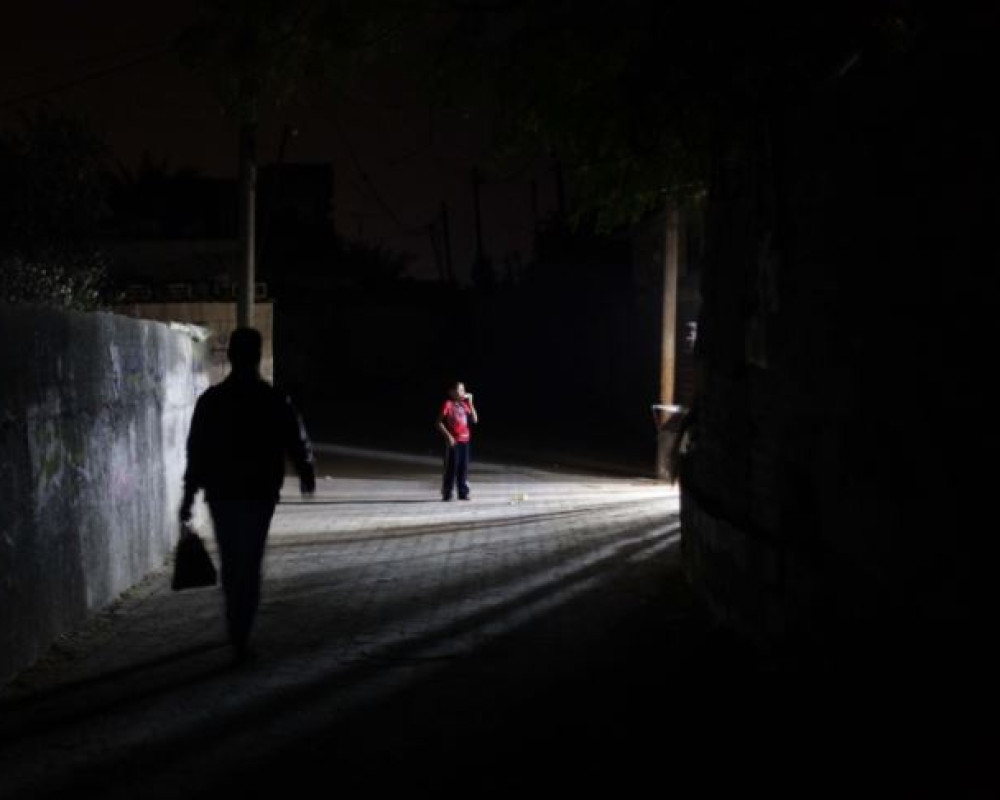
Her experience is one example of how the electricity crisis reaches far beyond darkness. For others in Gaza, unreliable and expensive electricity is directly affecting their ability to work, preserve food and study.
Ahmed al-Mufti, 50, runs a shop selling ice cream and other frozen products. His two married sons and two of his brothers work with him, and the shop's income supports five families.
The shop depends on electricity from a private generator.
A 2025 report by the Gaza Chamber of Commerce and Industry found that electricity supplied by local generators was costing between 30 and 35 shekels per kilowatt-hour, compared with about four shekels before the war. The report attributed the increase to the high cost and limited availability of diesel, as well as shortages of maintenance parts and oil.
Ahmed pays about 30 shekels for every kilowatt-hour he uses.
But even when he can afford the electricity, it is not guaranteed.
The generator supplying his shop broke down and remained out of service for about a week, forcing him to close. “I was happy with my work. It was not just a source of income for me; it was a source of happiness,” Ahmed said.
“I used to serve ice cream to people with great joy. I was happy watching children eat the ice cream we made. I had many customers who loved our products.” “I lost all that happiness I used to create for myself and for others. I also lost my source of income.”
For businesses selling frozen food, unreliable electricity creates another risk: products can quickly spoil.
Khaled Abdeen sells frozen meat and fish. When electricity is unavailable, he has to race against time to sell his stock before it melts.“I spend the day worried, trying to sell as much frozen food as quickly as possible before the ice melts,” Khaled said.
“If that happens, I sometimes have to sell it for half the price, at a loss, so it does not spoil.”
For Khaled, the electricity shortage has changed the way he runs his business. He is no longer thinking only about customers and sales, but also about how much time remains before his products lose their value.
For Mohannad Abu Sel, 28, the problem is even more immediate.
Mohannad is a barber who learned the profession from his family. He has a young child and relies on his daily income to meet his family's basic needs.
When the generator supplying his shop stops, his income can stop with it.
“A customer may come to the shop and I may be able to work, or they may come and leave,” Mohannad said. “My daily income depends on whether electricity is available.”
For Shahd Saber, a medical student, electricity has become an additional cost of getting an education.
Shahd needs electricity and internet access to attend university lectures online. When she cannot study at home, she goes to places that provide electricity and internet access to students and people working online.
She pays five shekels an hour. Studying for two or three hours a day means spending 10 to 15 shekels simply to attend her classes. “Going to a space to study and work under these difficult circumstances has become an additional cost and a financial burden,” Shahd said.
The dependence on generators is part of a wider energy crisis.
According to OCHA, Gaza has remained without regular grid electricity since October 2023, leaving essential services heavily dependent on generators and fuel supplies. Fuel shortages have affected hospitals, bakeries and water and sanitation facilities.
More recently, Reuters reported on September 10 that Gaza continues to rely heavily on generators while shortages of engine oil, spare parts and fuel are making it increasingly difficult to keep them running. The shortages are affecting hospitals as well as homes and daily life.
Reuters, September 10, 2026:
Some alternatives are being used. In July, OCHA reported that solar-powered lamps were being distributed to 7,200 households across 26 displacement sites in Gaza.
OCHA, July 3, 2026:
But a lamp can provide light without solving every problem caused by the loss of electricity. It cannot keep frozen food from spoiling, power a barber's equipment, provide the internet needed for an online lecture or keep a phone charged for an urgent call.
For Badria, the consequence was a missed flight and another wait to reunite with her husband.
For Ahmed, it was a week without his business.
For Khaled, it is the daily risk of losing his stock.
For Mohannad, an unavailable generator can mean a day without income. And for Shahd, electricity has become another expense she must pay simply to continue her education.
In Gaza, electricity is no longer only about whether a light comes on.
It can determine whether a business opens, whether food remains frozen, whether a student attends class or whether a phone receives the call that determines what happens next.
The electricity may return after a blackout.
The opportunity lost during those hours may not.
For Badria, that opportunity was a flight out of Gaza.
She is still waiting for another one.