JENIN, West Bank /PNN /
In the town of Arraba, southwest of Jenin, Palestinian farmer Tareq Al-Shaer is facing the loss of the grape farm he has spent years cultivating after receiving, according to his account, a notice ordering its removal within 48 hours.
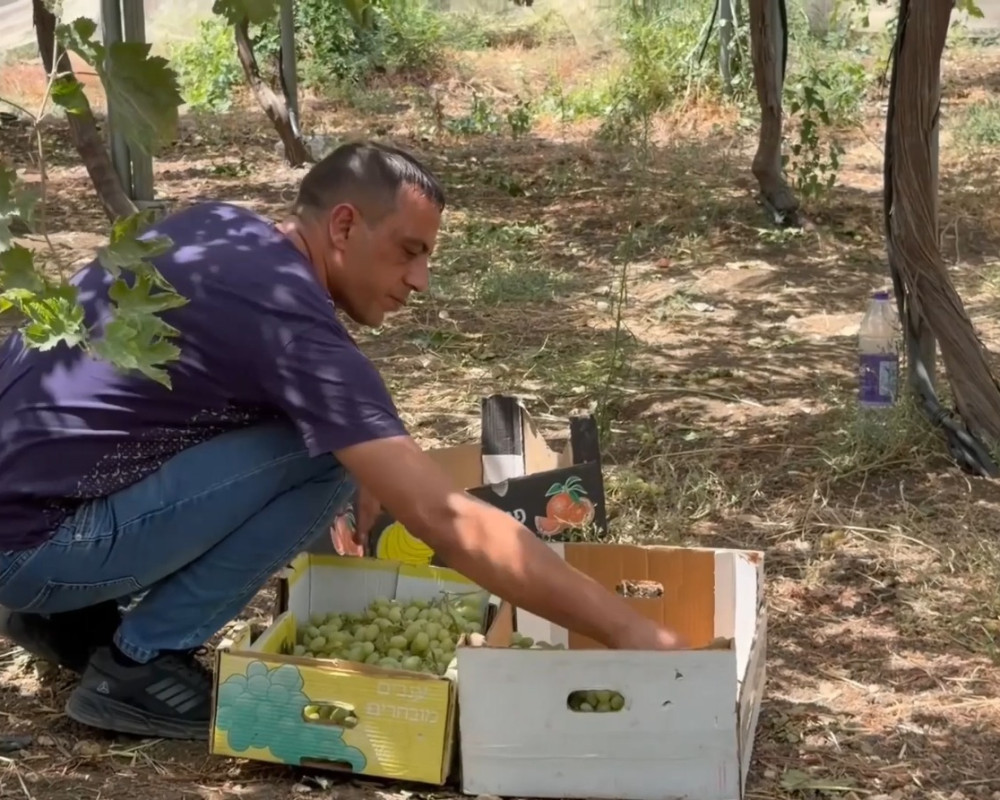
As he waited for a harvest that had taken more than eight months of work, Al-Shaer, relatives and friends rushed to pick the grapes in an attempt to salvage as much of the crop as possible. He fears losing about 750 grapevines, along with agricultural structures and equipment that provide a vital source of income for his family and about 15 people who depend directly or indirectly on the farm.
Al-Shaer said he was notified at about 10 p.m. Friday of a decision to remove the entire farm. The property includes a room, a shed, agricultural facilities and equipment, as well as about 750 grapevines, some growing on metal structures, in addition to irrigation networks, water tanks and other supplies.
The 48-hour deadline left him facing major losses, particularly because the grapes still needed another 20 to 25 days to fully ripen and become ready for harvest, he said.
With the help of relatives, friends and local residents, the family began harvesting the crop urgently in an effort to save part of the season's production and reduce losses incurred over months of spending on water, irrigation, fertiliser, pesticides, weeding and other agricultural work.
“This season represents about eight months of continuous work,” Al-Shaer said, describing the vineyard as a key source of income for his family and comparing the grape harvest to the olive season in its importance to their livelihood.
Some of the vines are about 15 years old, he said, adding that he sees them as the product of years of care and hard work, rather than trees that can simply be uprooted.
Al-Shaer said this was not the first time his farm had suffered losses and damage. He recalled that a water tank had previously been placed in the area under what he was told was a “military order.” Water was discharged near the grapevines, he said, causing the fruit to be affected and much of it to turn black.
The area had once been quiet, he said, but after a single caravan was placed there, more caravans followed and the site expanded. Al-Shaer said the expansion was accompanied by attacks on farmers, land seizures and the cutting of olive trees.
He stressed that the losses facing farmers go beyond their immediate financial value.
“Take whatever you want, but don't take the land and don't cut the grapevines,” he said.
Agricultural land in the area, he added, is an important part of the Palestinian food supply, and the pressure facing farmers is weakening their ability to continue farming and, he believes, pushing them to abandon their land.
Al-Shaer estimated that about 15 people depend directly or indirectly on income from the farm and its annual harvest, which requires continuous spending on water, fertiliser, pesticides, weeding and agricultural services.
What hurts most, he said, is the prospect that years of work and investment could be wiped out by a short notice.
Palestinian farmers work throughout the year to reach harvest season, only to find themselves facing the loss of their land, trees and livelihoods, Al-Shaer said.
This video was produced with financial support from CFI, Expertise France and the European Union. The beneficiary is solely responsible for the content of this document, which in no way reflects the views of CFI, Expertise France or the European Union.