Gaza / PNN / Nesma Al-Harazine —
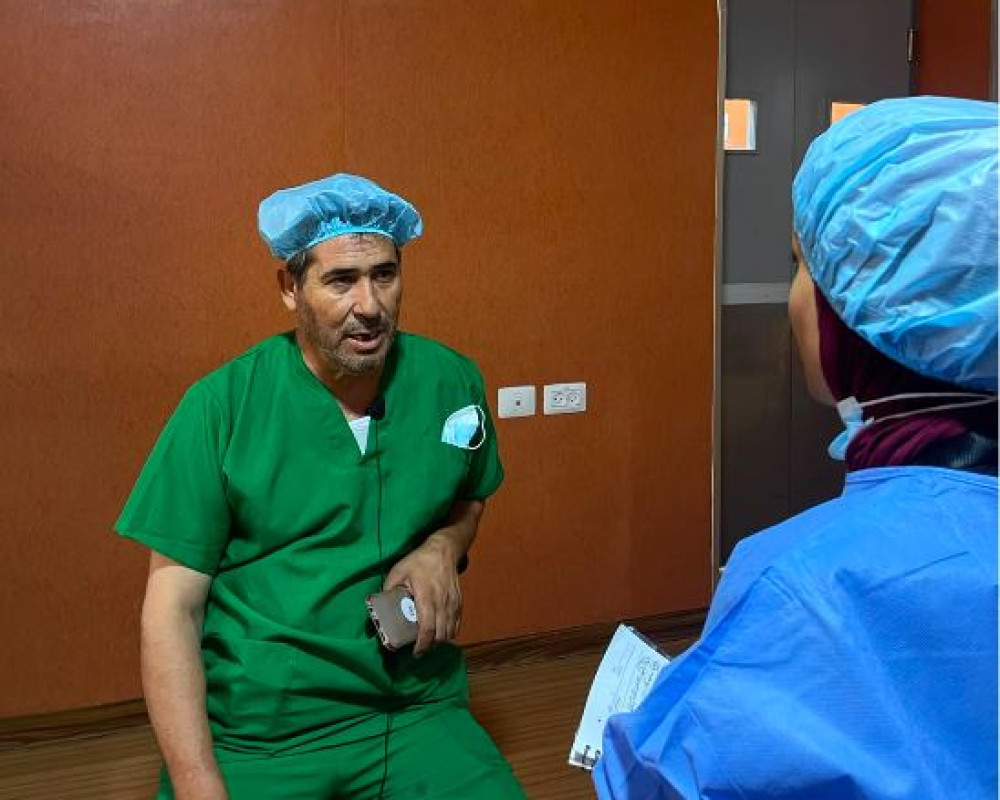
In the corridors of the Arab Baptist Hospital in Gaza City, amid ventilators and resuscitation equipment in operating rooms, the smell of disinfectant mingled with blood. A trembling hand was not shaking from fear, but exhaustion. There were few bandages and the bleeding was continuous. Issam Abu Ajwa, a specialist in general surgery, had no luxury of time to think or worry.
From the first hours of the war in Gaza, Dr. Abu Ajwa went directly to the Baptist Hospital. The number of general surgeons at the hospital could be counted on one hand, while huge numbers of dead and wounded arrived from eastern Gaza, with more than 200 cases coming from the Zeitoun, Shuja'iyya and Daraj neighbourhoods and other eastern areas.
Dr. Abu Ajwa began working as an unpaid volunteer. A retired surgeon from the Palestinian Health Ministry, he decided to return to the operating room when the war began and the number of surgeons became critically low.
"I started the war as a volunteer, working hard for the injured patients because there were very few surgeons," he said.
The Arab Baptist Hospital was not spared direct bombardment and other attacks. On Oct. 17, 2023, Israeli forces struck the hospital. The Palestinian Health Ministry said at the time that 500 people were killed and hundreds more wounded. The incident was described as the deadliest in Gaza since the start of the war.
Medical staff said at the time that a particular type of bomb had caused unprecedented injuries. Body parts and the remains of children and other victims were found across the hospital buildings, while medical teams transferred many of the wounded to Al-Shifa Hospital in Gaza City.
"The hospital grounds and its terraces turned into a river of blood," Abu Ajwa said with grief. "We were receiving the remains of the dead. Artillery shells shook the operating rooms. We ran to the scene. Most of the victims were children, women and elderly people."
The Baptist Hospital Under Siege
On Nov. 15, 2023, the Arab Baptist Hospital was the only functioning hospital in northern Gaza amid the Israeli ground operation. It had effectively become a first-response medical station receiving hundreds of wounded people.
On Nov. 16, 2023, the Palestine Red Crescent Society said Israeli forces, including tanks, had imposed a complete siege on the hospital for several days and prevented medical teams from reaching and treating the wounded.
The siege continued for a second consecutive day on Nov. 17 and a third day on Nov. 18, amid heavy shelling and gunfire. Palestine Red Crescent medical teams remained trapped inside the hospital and were unable to reach wounded people outside.
"We worked intensively for 72 hours without sleep or food," Abu Ajwa said.
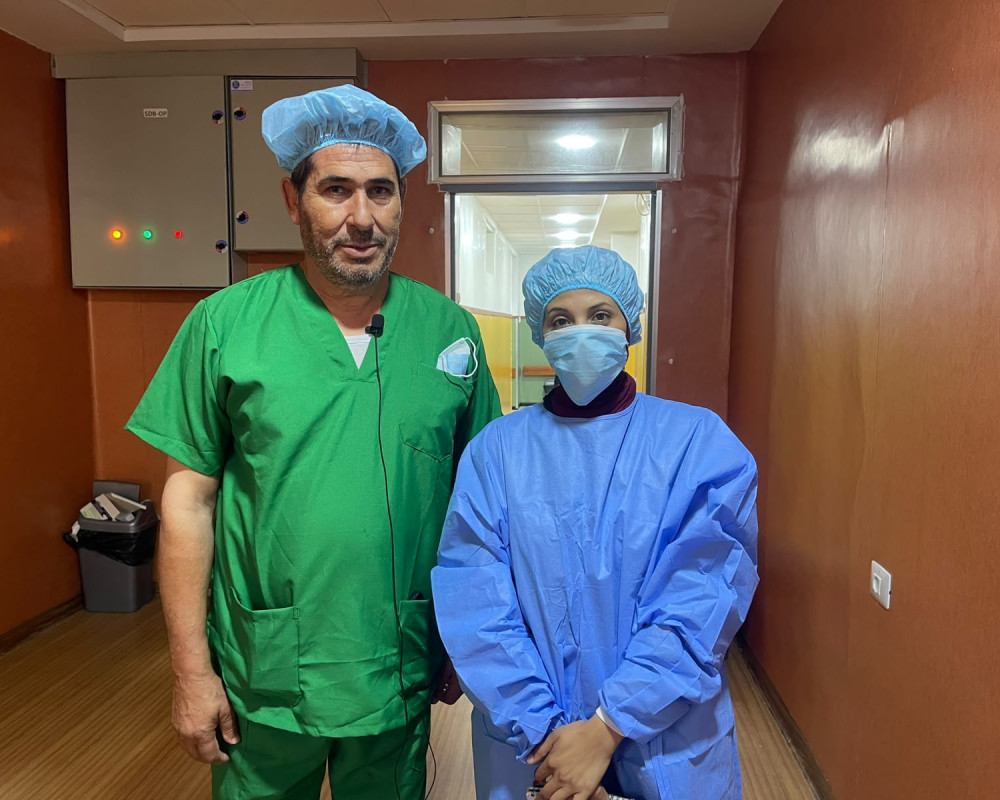
Despite the attacks and heavy bombardment surrounding the Baptist Hospital, it did not close its doors. Medical staff remained at their posts despite the violence, cleaning wounds by the light of mobile phones and sterilising instruments with the limited water available inside the hospital.
Operations continued day and night. The medical staff became the hospital's main line of resistance, trying to provide patients with the basic necessities of survival during bombardment and siege.
"We cooked rice and bread inside the hospital so that doctors and patients would have something to eat, amid the war and the siege imposed by the occupation forces and their tanks," he said.
The Moment of Arrest
Dec. 18, 2023, remains etched in every detail in Abu Ajwa's memory.
The day began with intense bombardment along Omar Al-Mukhtar Street, adjacent to the hospital, before Israeli forces surrounded the Baptist Hospital from all sides and cut it off from its surroundings.
Inside, patients, wounded people and doctors tried to take shelter behind what remained of the walls.
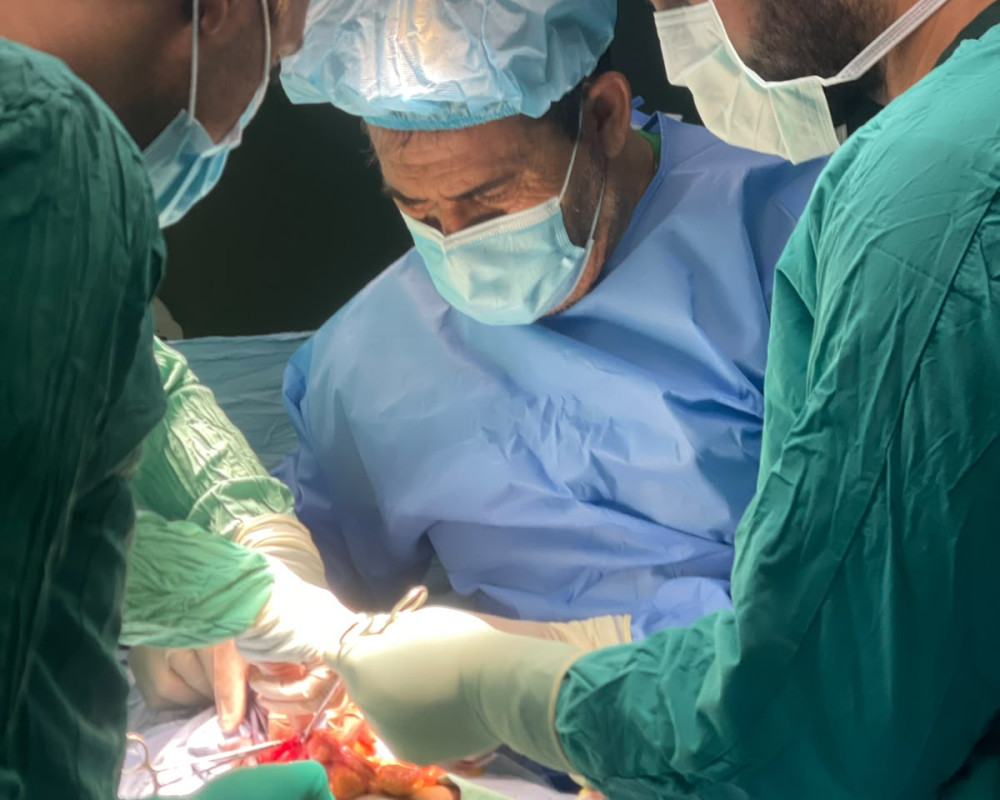
Abu Ajwa and a small number of doctors remained inside an operating room, performing surgery on a 3-year-old boy, his family's only child. The boy's internal organs were outside his abdomen.
Meanwhile, Israeli forces used loudspeakers in the hospital courtyard to order the doctor and the rest of the medical staff to come outside. He did not leave. He continued working as though the outside world had fallen silent.
"Humanity took over me and I remembered my children," he said. "So I stayed and continued the operation on the child. The soldiers were calling through loudspeakers, but we did not leave the operating room. I stayed until we were sure the child was safe, despite the shortage of medicines and basic medical supplies."
When the operation ended, soldiers stormed the operating rooms at the same moment Abu Ajwa and his team completed the surgery. They pulled him away from the child's exposed organs while he was still wearing his bloodstained surgical uniform.
He realised then that the danger was not over and that surgeons themselves had become targets of the Israeli military.
Dr. Abu Ajwa was arrested in front of his family, who had been displaced to the hospital, and in front of patients and wounded people. He was restrained along with several doctors and the nurse who had been working with him.
He was no longer the doctor standing behind an operating table. He had become a detainee, taken outside the hospital amid the sounds of patients, soldiers and aircraft. He knew he was being taken somewhere far away, but he did not know where.
During Detention
Abu Ajwa's detention began brutally. He and those detained with him were blindfolded, their hands and legs restrained, thrown to the ground and beaten. Interrogators subjected them to insults, including being called "animal."
Abu Ajwa described his detention as resembling a kidnapping by a group operating under the Israeli military. He said they were denied food for long periods and were prohibited from speaking or even whispering to one another inside the detention facility. They were required to sit on chairs without bending over and were subjected to severe beatings, harsh interrogation and continuous humiliation.
"The hardest days were in Sde Teiman detention centre, in a tightly sealed room, with disturbing noises around the clock," he said. "The floor was covered with gravel. You could not walk, sit or pray. They sprayed cold water on us during cold weather, and we had no clothes other than the single prison uniform."
He recalled an incident on a cold December morning.
"I asked my jailer for a toothbrush because I was in pain and had fractures from the beatings. He brought me a toilet brush instead and beat me again," he said.
Despite the harsh conditions, Abu Ajwa said his family was the only thing occupying his thoughts. Eight months passed without him knowing anything about them, while they knew nothing about him. All he wanted was a single piece of information to reassure him that they were alive.
A picture of his family at the time of his arrest remained with him throughout his detention.
Recalling his final days in prison in January, he said: "I asked to take a shower so I could perform my religious duties. The jailer forced me to take off my clothes and shower in cold water at 5 a.m."
The Moment of Release
Between noon and the afternoon, Abu Ajwa was placed in a closed vehicle, blindfolded, his head covered and his hands restrained, along with a group of other detainees. The driver deliberately drove over bumps, while the metal seats had become hot under the sun.
He was taken back to Sde Teiman, believing that another interrogation would begin. But the following morning, they were ordered onto an Israeli military bus coordinated by the International Committee of the Red Cross.
He did not know he was approaching freedom.
On July 1, 2024, after about eight months in detention, Dr. Abu Ajwa was released. He did not know that the journey would end outside the detention facility, nor that the first things he would seek after regaining his freedom would be rest, his family and his profession.
He found himself lying on the ground in Deir Al-Balah. He got up without knowing exactly where he was, but realised he was free.
When asked where he went after his release, his answer was clear: "To Al-Aqsa Martyrs Hospital in Deir Al-Balah."
He paused before continuing: "I did not spend much time thinking. I asked people in the street which way the hospital was. I reached the hospital and immediately returned to work after leaving detention."
Abu Ajwa was struck on the arm during interrogation, and the marks of the beating remain visible on his wrist. He is no longer able to hold some medical instruments as he once did, including a surgical scalpel.
"The interrogator who beat me in prison told me he would prevent me from returning to work as a surgeon," he said quietly. "But I told him, while he was torturing me, that I would return to work immediately if I were released."
The interrogator laughed hysterically before beating him more violently.
But Abu Ajwa's words were not a challenge. They were a promise he had made to himself.
The administration of Al-Aqsa Martyrs Hospital in Deir Al-Balah welcomed him back, and he immediately returned to work as a way of reclaiming himself despite the pain in his hands and legs.
A Reunion After Nearly a Year
After his release, Abu Ajwa still did not know where his family was or whether they were safe. Months passed as he worried about them until a relative brought him good news: His family was still in northern Gaza, trapped there by a barrier erected by the Israeli army separating the north from the south of the Gaza Strip.
Only then did he learn that his wife and children were still alive.
"I heard the voice of my eldest daughter, Zainab, 13, over the phone as soon as I obtained her mobile number," he said. "I could not hold back my emotions. I cried, and she broke down in tears."
Abu Ajwa has two daughters, the eldest 18 and the other 15. He also has two sons. One is a fourth-year medical student in Gaza, while the other graduated from secondary school in 2026 and hopes to study medicine as well.
During the first ceasefire in January 2025, he travelled from the south to the north and met his wife and children for the first time.
The emotions were scattered, mixed with pain, grief, joy and shock.
Abu Ajwa sits silently, clasping his fingers as he recalls the difficult moments.
"The sound of aircraft takes me straight back to the detention centre and the moment of the raid," he said. "I still suffer from anxiety and fear. My wife notices changes in my sleep and eating habits."
Things that had once been ordinary in Abu Ajwa's life before his detention are no longer the same. The sleep he was deprived of, the way he eats and the pain in his legs and hands have all become part of his daily routine.
Abu Ajwa tries to overcome his memories through prayer.
"Whenever I remember how the interrogators treated me to make me hate my profession, I immediately turn to prayer," he said.
He continues to suffer from fractures and pain in his hands and is no longer able to perform operations alone as he once did. He is undergoing physiotherapy and trying to treat himself.
At the Baptist Hospital, patients' attachment to him and the respect of the medical staff are evident. He is regarded as a beloved figure whose presence brings reassurance.
"I feel a greater responsibility towards the patients, as if I am in a challenge," he said.
Everything reminds him of the past, but he refuses to allow it to overcome his present.
The Hardest Moments of His Life
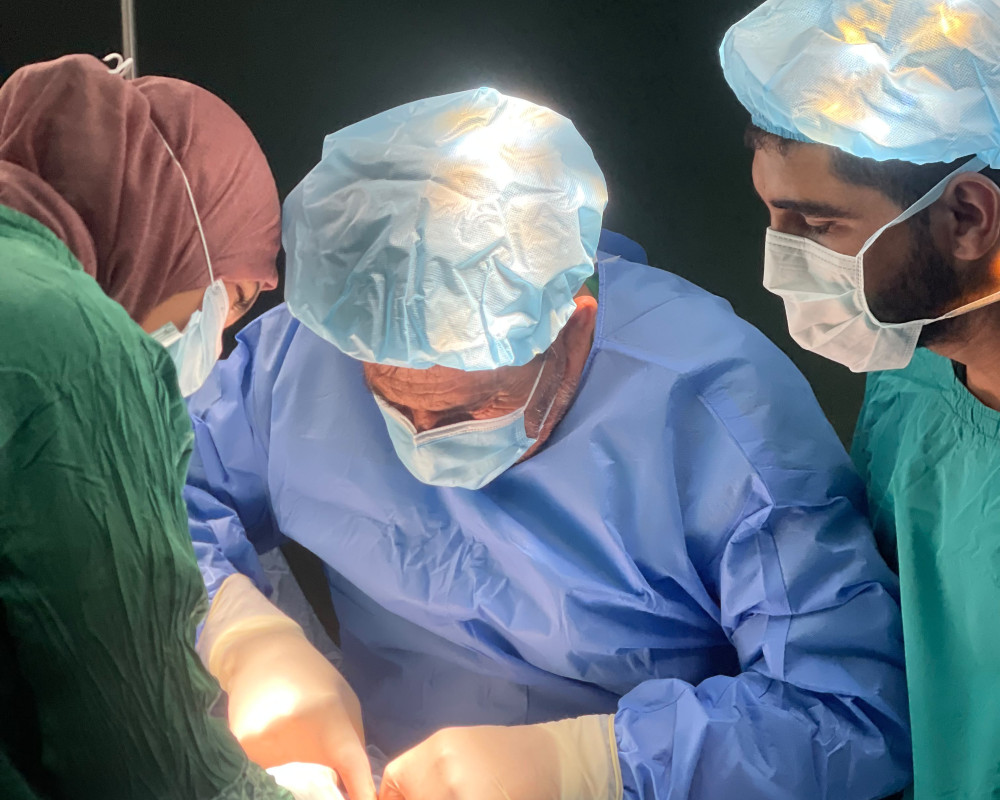
Asked about the hardest moments of his life, Abu Ajwa pointed to the death of a friend in front of him while they were working. He was unable to provide medical assistance because shells were raining down around them.
Asked what he would do if given the opportunity to leave Gaza to work and settle elsewhere, his answer was firm.
"No. I will not leave my homeland and go away. Those who leave are the occupiers, not the people of the land."
Today, Dr. Abu Ajwa continues to stand in operating rooms, carrying the physical scars of detention, loss and displacement. His hand still hurts when he grips certain instruments, while his memory continues to replay the sounds of aircraft and the detention centre.
Yet he continues to wear his white coat as a declaration of defiance that he has not lost his profession.
"A doctor was created to serve patients," he says, embodying the image of a physician who remains by his patients' side.
In closing, Dr. Issam Abu Ajwa said: "What we want from the world and international organisations is justice for Gaza and the right of its people to live. A ceasefire has not ended the suffering. The crossings remain closed, medicines are in short supply, and bombardment and injuries continue. Hundreds of patients need treatment outside Gaza."
This written report was produced as part of the Media Support in Times of Crisis project, implemented by Palestine News Network in cooperation with the Palestine Journalism Hub.