Hebron, West Bank / PNN /
A women-led initiative in the town of Bani Na’im, south of Hebron in the occupied West Bank, has emerged as a model of productive cooperation between men and women amid worsening economic conditions driven by Israeli closures that have sharply increased unemployment among men.
The initiative, led by women from Bani Na’im, involves forming a women’s collective — or cooperative — focused on agriculture, food processing and integrated livestock and poultry farming. The project has enabled women to stand shoulder to shoulder with men in confronting mounting political and economic pressures.
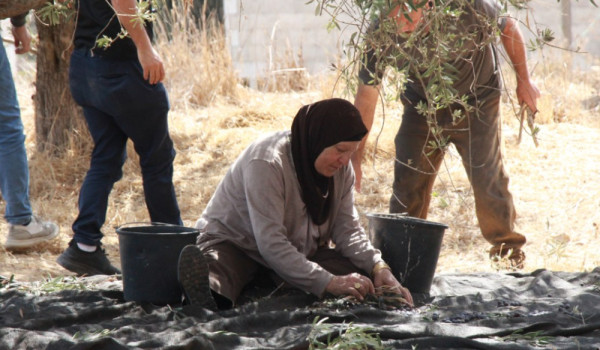
Like many communities across Hebron district, Bani Na’im faces significant challenges, most notably the daily expansion of settlement outposts and the growing number of settlers grazing their flocks on Palestinian land, depriving local farmers of vital resources. In response, women in the town decided to cultivate the land to reinforce residents’ resilience and prevent it from being left abandoned.
Asmaa Zaidat, one of the initiative’s leaders, said her town’s land is at constant risk of confiscation. “The steadfastness of families in these areas protects the land from seizure,” she said, noting that many households rely on livestock farming, using dairy production both for family consumption and as a source of income.
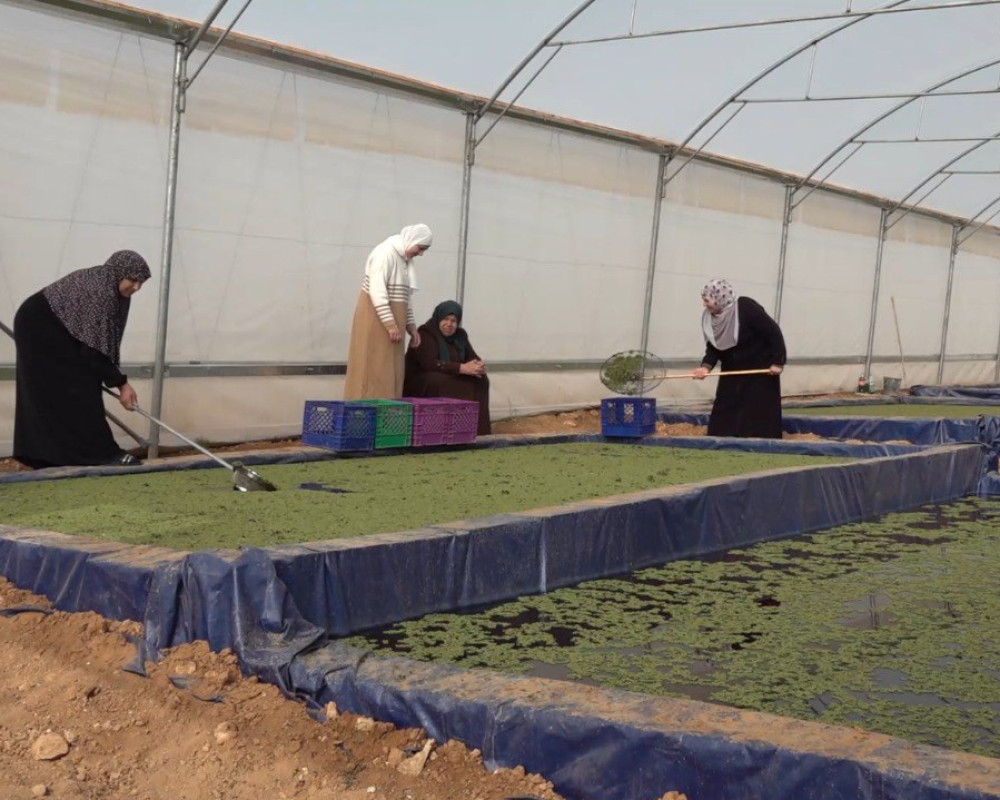
The women’s cooperative carries out a range of agricultural and agri-economic activities. What sets it apart, however, is its adoption of Azolla cultivation as an alternative feed for livestock. Grown in water ponds, Azolla has significantly reduced the high costs of animal feed and is also used for poultry, easing the financial burden on farmers.
Zaidat raises about 30 sheep — including ewes and lambs — and poultry for household consumption. With feed prices soaring in Palestine, she previously needed about two tonnes of bran per month, costing around $700. She turned to local feed production through Azolla farming, which now supplies her livestock’s needs, with sheep consuming about 10 kilograms daily.
Zaidat said the cooperative has enabled women to support their families directly. “Anything the household needs, we buy it ourselves,” she said. “There is no difference between us and our husbands. In these circumstances, they are unemployed and there is no work. We share the same responsibility.”
“I believe that any success story must come from the heart of the problem,” Zaidat added. At the start of the war, closures prevented access to animal feed, pushing women to search for alternatives. Through social media and technology platforms, they discovered Azolla cultivation. They began with small ponds before expanding to larger-scale production using more advanced techniques.
“Each type of farming requires specific techniques and production conditions,” Zaidat said. Azolla grows rapidly in water ponds, can be harvested weekly, has low operating costs and is rich in protein, containing between 25% and 30%.
Women involved in cheese and dairy production reported clear improvements after using Azolla feed, including enhanced cheese flavour, faster curdling times, increased milk yield by around 5%, higher protein content, greater cheese output and improved egg production and size among laying hens.
Despite its success, the project was not without obstacles. Women in Bani Na’im said the initiative initially faced financial and social challenges, but persistence and cooperation with multiple institutions helped turn the idea into reality.
Jaziya Braira, another participant in the initiative, said the home-based project has paid off. “Our products are excellent, and we meet as women to share our concerns and experiences,” she said. Since the COVID-19 pandemic, hardship has affected nearly everyone, but the project has allowed women to support their husbands and households while expanding production to include ghee, traditional yoghurt, molasses and a range of homemade agricultural products, including grape-based sweets.
“Life is about cooperation and love,” Braira said. “Women support men, and men support women. We want to raise our children properly, and we cannot leave them without education because of the cost of schools and universities.”
Returning to the broader vision of the initiative, Zaidat stressed that it goes beyond economic empowerment to strengthening the identity of rural Palestinian women. “We are working to reinforce women’s identity in these areas, support their resilience and promote women-led entrepreneurial projects such as Azolla farming,” she said. “Our women are creative. Institutions must recognise this excellence, and the Ministries of Agriculture and Labour should work together.”
“What is needed now is both financial and moral support,” Zaidat said. “Women of Bani Na’im are strong and resilient. They are the primary breadwinners for their families and play a vital role in strengthening the resilience of the local community.”
This story was produced as part of the Qarib project, implemented by the French media development agency CFI in partnership with and funded by the French Development Agency (AFD).
إذا رغبت، أستطيع: