Ramallah / PNN / Wisal Abu Alia-
From the village of Al-Mughayyir, northeast of Ramallah — a community facing constant threats from settlement expansion and displacement — 28-year-old Fadi Abu Alia has carried a dream that has grown with him since childhood.
There was no football pitch in his village, no proper space to nurture talent. What Abu Alia did see, however, was something he considered far more important: untapped potential among children who needed only guidance and opportunity to shine.
From a childhood dream to a community project
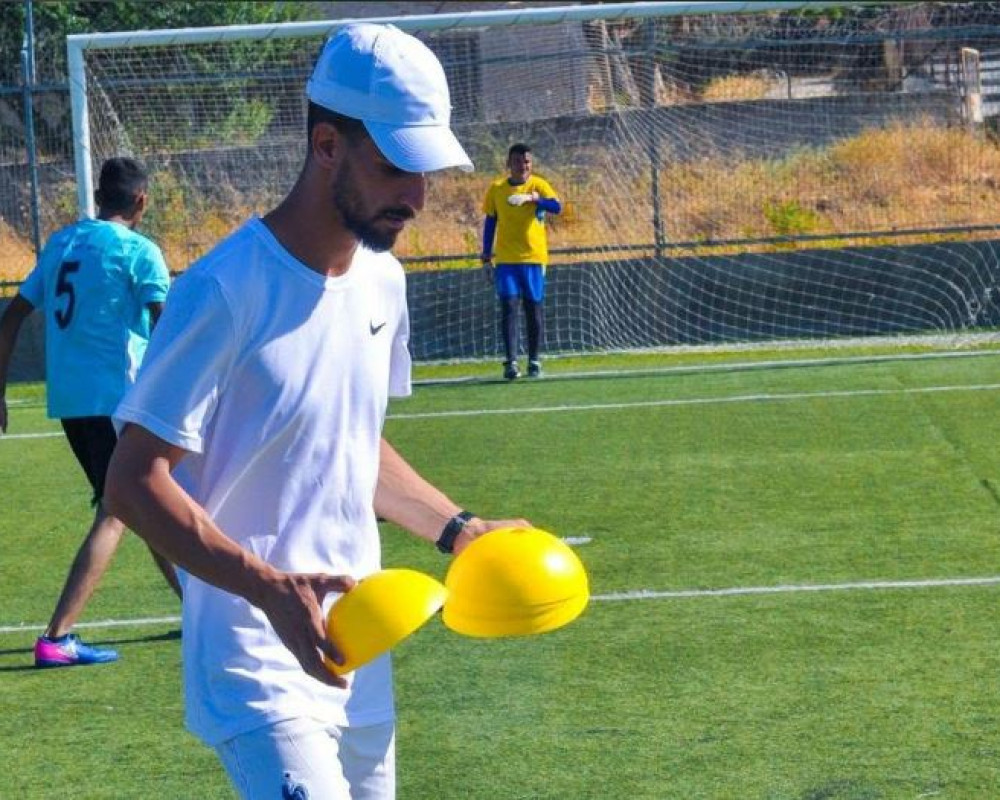
Driven by that belief, Abu Alia founded the Al-Mughayyir Academy with modest resources. Around 70 trainees, aged between five and 17, joined the initiative, built on a clear goal — to turn village children and teenagers into confident, ambitious players.
Despite the lack of facilities, the academy quickly made a name for itself across the occupied West Bank. It has won more than 20 tournaments, with its players regularly standing on podiums and its name appearing prominently in competitions, even though Al-Mughayyir itself has no football field.
A dangerous journey and a village without a pitch
Abu Alia said the path to success was far from easy. Al-Mughayyir lacks a football pitch, posing a major obstacle to developing players’ skills. Even reaching the nearest field in the village of Turmus Ayya is fraught with danger, as the route passes close to a settlement outpost, turning each training trip into a daily risk to players’ safety.
Still, Abu Alia and his players refused to give up. Carrying their equipment, they defied fear and danger, determined to keep their dream alive and assert their presence despite the circumstances.
Gaining experience beyond the village
A turning point came in 2023, when Abu Alia joined the Joseph Blatter Youth Academy as a coach. The experience, he said, deepened his understanding of professional coaching and sports management, and helped him learn how to develop players in a structured, progressive way.
He credited international coach Abdel Nasser Barakat with playing a key role in sharpening his skills — an influence that was soon reflected in the performance and organisation of the Al-Mughayyir Academy.
As responsibilities grew, Abu Alia brought coach Basma Al-Mansi on board, making her the first female football coach in the village. Her appointment marked a qualitative shift, helping organise the academy’s work, raise performance standards and challenge traditional perceptions of women’s roles in sport.

Confidence, recognition and a growing network
Abu Alia said the impact has gone beyond football. Children and young players at the academy have gained confidence and expanded their social circles, forming connections with players from other villages and cities.
“They became known and respected,” he said. “People now see them as a success story unfolding before their eyes — a collective dream rising despite the harsh reality imposed by settlement activity and the constant threat of displacement facing Al-Mughayyir’s residents.”
A vision that reaches beyond the village
Looking ahead, Abu Alia said his ambition is for the academy to produce players capable of representing the Palestinian national team, and others who can compete professionally in international leagues.
“The message is simple,” he said. “We deserve to dream. We deserve to live. And we deserve to build a future like children everywhere else in the world.”
For Abu Alia, the academy is more than a sports project. It is a story of perseverance, belonging and a dream born in a village under threat — one that chose to grow rather than fade.
This story was produced by Palestine News Network (PNN) as part of the “Steps” project, implemented through Media Plus and funded by the European Union.