GAZA (PNN) — By Hanan Al-Rifi
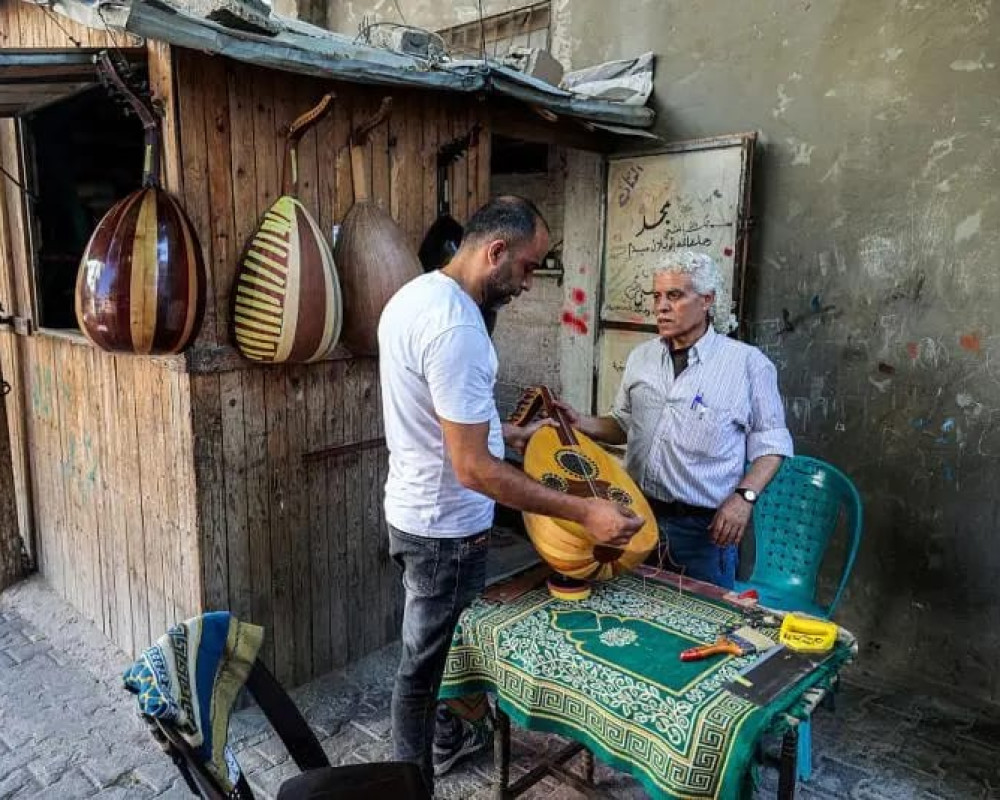
Under a sliver of light filtering through an opening in a small tent pitched over the rubble of a refugee camp, 50-year-old Suhail Abu Shawish sits repairing musical instruments that survived the Israeli offensive of October 7, 2023. Wiping sweat from his weathered face, his features etched with fatigue, he works as dust and grey ash swirl around him with the passing of people nearby.
Around his plastic chair lie damaged instruments pulled from the debris: violins missing tuning pegs and ouds with snapped strings crushed under bombardment. With steady hands, Abu Shawish uses metal pliers to remove worn strings and replace them with improvised alternatives, tightening them until a faint musical note briefly rises above the persistent hum of drones overhead.
Before the war reduced Gaza to ruins, the enclave had a vibrant musical life. Institutes opened daily, youth bands rehearsed new compositions, and children’s orchestras trained with hopes of a future beyond blockade and conflict. Few imagined that rhythm would one day become a memory.
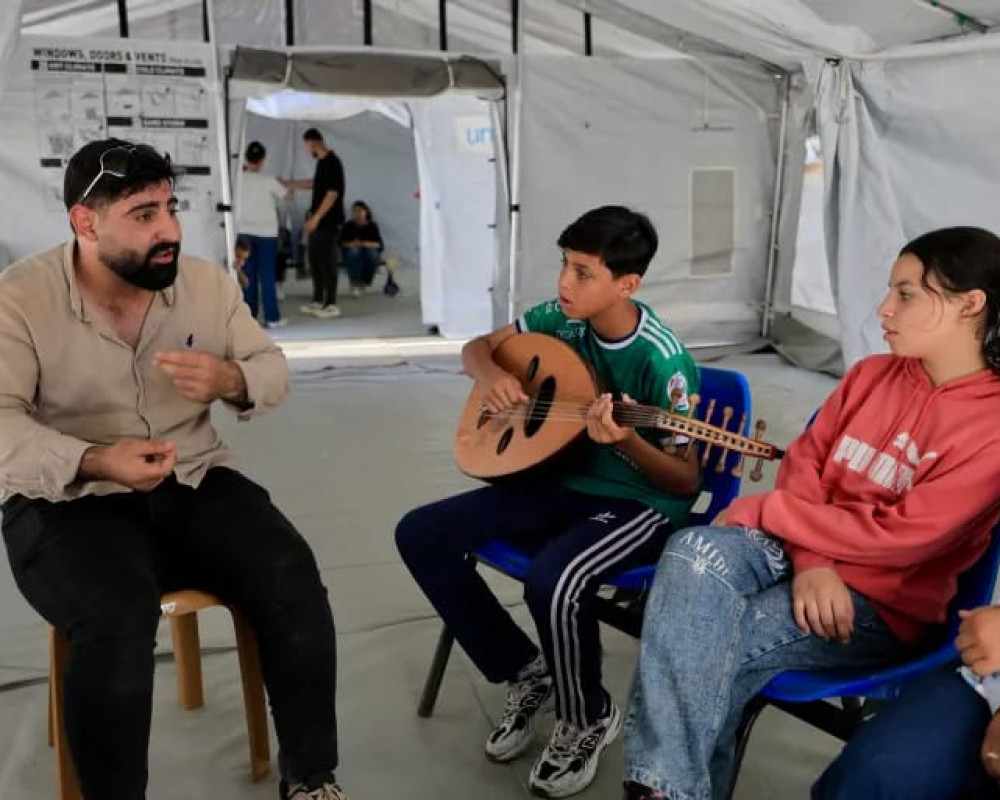
That changed with the October 2023 offensive, which saw Israeli strikes hit key cultural institutions, including the Edward Said National Conservatory of Music and the Nawa Center for Culture and Arts. Performance halls fell silent. Yet music proved resilient, re-emerging in displacement camps, where melodies now serve as psychological refuge for children and families confronting daily loss.
Across Gaza, musicians have taken on a personal struggle to revive damaged instruments and preserve their craft.
Kilometers from Abu Shawish’s tent, musician Ahmad Abu Amsha, displaced to the coast of Al-Zawaida in central Gaza, lost a studio he had built over years in Beit Hanoun. Microphones, cables, instruments and recordings were buried under rubble.
“The destruction tries to convince me that everything is over,” he said quietly. “But I realized that a studio can be destroyed — the music inside me cannot.”
After being displaced more than 15 times, Abu Amsha now searches for broken instruments he can restore. With supplies scarce, he improvises. Using plastic water pipes, he fashioned a wind instrument resembling a flute, carefully adjusting it until it produced sound.
Each repaired instrument, he said, carries a message: “Damage does not always mean the end.”
Despite fear and repeated displacement, he continues performing for children in camps. “I live this war like everyone else,” he said. “I move from place to place carrying my guitar to sing for children.”
For him, restoring instruments goes beyond music. “We will need to rebuild people just as we rebuild stones,” he said. “Children are where reconstruction must begin.”
In one session, while singing a traditional song with children, he was briefly transported back to his hometown. “For a moment, I felt I had returned home,” he said.
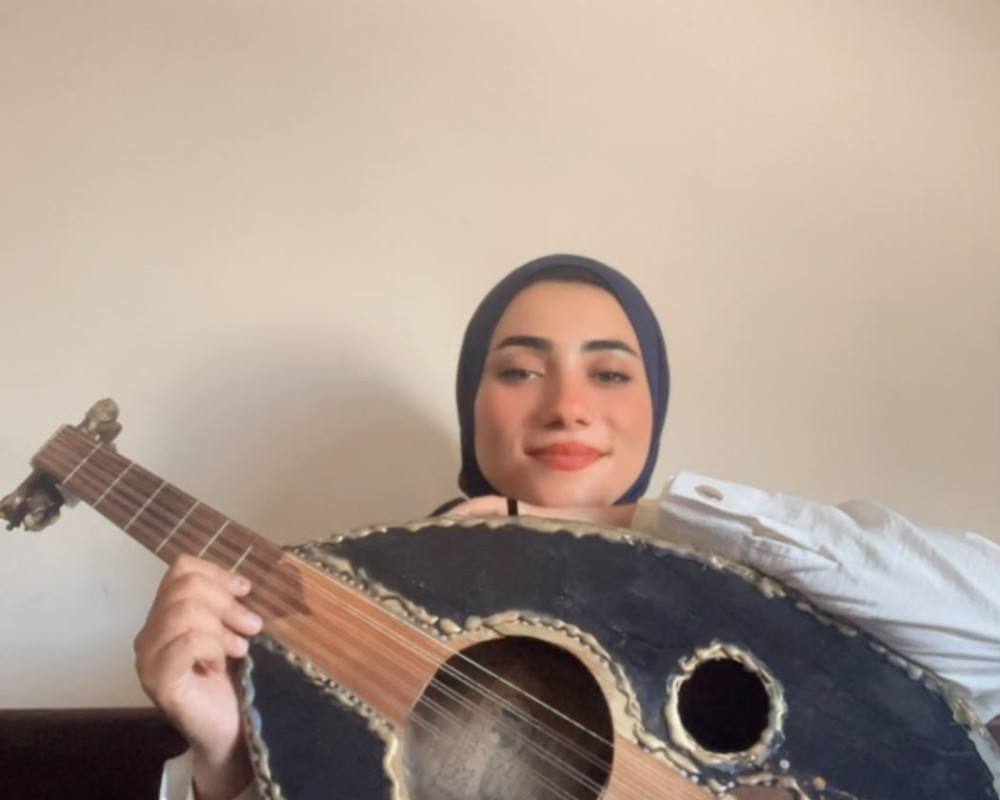
Elsewhere, near Netzarim south of Gaza City, journalist and musician Malak Abu Odeh continues to pursue her musical ambitions despite displacement. Carrying her oud daily, she walks long distances from her tent to attend lessons, often waiting under intense heat before reaching the music institute in Nuseirat.
“Whenever I play, I feel like I’ve returned to my childhood and my dream before the war,” she said. “Music helps relieve the psychological pressure and pain of loss.”
But even her instrument has not escaped hardship. With limited resources at the institute and few instruments available, she often takes her oud back to the tent to practice. One morning, she opened its case to find that rats had chewed through all its strings.
“I stood there in silence,” she said, unable to find replacements or access a repair shop under displacement conditions. The incident forced her to halt her training once again, highlighting how even the simplest details of daily life can obstruct artistic pursuit.
Despite the challenges, she remains determined to continue, hoping music will help restore a sense of normalcy.
Gaza’s once-rich cultural landscape has been largely devastated. A report by the Center for Protection of Human Rights documented damage or destruction to 316 out of 325 cultural and heritage sites. Data from the Palestinian Ministry of Culture shows that 32 cultural institutions and theatres have been destroyed or partially damaged, while 12 museums have permanently closed, along with nine libraries and eight publishing houses, with losses exceeding $17 million.
The ministry also reported that 10 musicians were killed in the 2023 offensive. The Edward Said National Conservatory of Music, which had served more than 500 students through direct and outreach programmes, was reduced to rubble in Gaza City, taking with it dozens of instruments — some beyond repair.
Amid the devastation, Gaza’s musicians continue to play, repair and create, turning fragments of destruction into fragile notes of survival.