Doha / PNN /
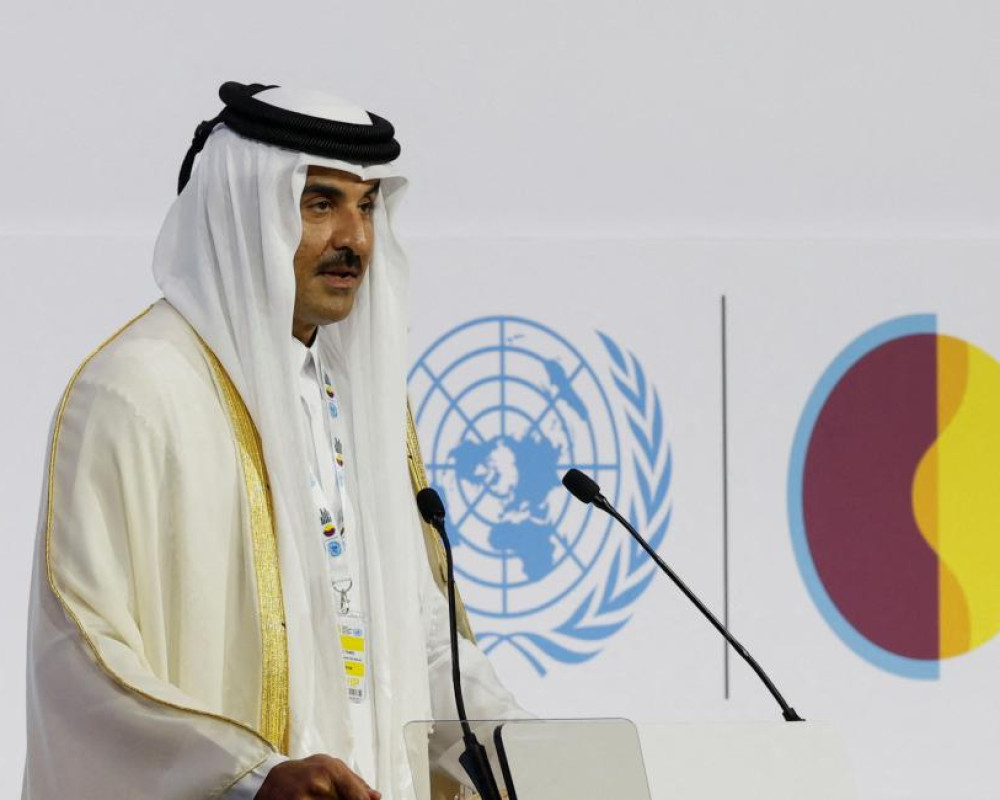
His Highness the Emir of the State of Qatar, Sheikh Tamim bin Hamad Al Thani, during the opening of the Second World Summit for Social Development in Qatar today (Tuesday), called on the international community to step up efforts and provide support to the Palestinian people for reconstruction and remaining steadfast on their land. He stressed that the Palestinian people need every possible form of assistance to address the catastrophic effects of the Israeli aggression on the Gaza Strip.
He expressed his shock at the horror of the atrocities committed in the city of Al-Fashir in Sudan, saying: “We can only stand in our shock at the atrocities committed in Al-Fashir in Sudan and condemn them.”
He noted that Sudan has been living through the horrors of war for two and a half years and that the time has come to end it and reach a political solution that ensures Sudan’s unity, sovereignty, and territorial integrity, emphasizing that social development cannot be achieved in societies without peace.
He affirmed that the State of Qatar will remain an active partner in the international community and a supporter of social development efforts, stressing that this summit is an occasion to reaffirm the spirit of solidarity in facing the challenges hindering social growth. The Emir stated: “Social development is not a choice but an existential necessity, and states must fulfil their commitments,” considering that the Doha Declaration will give momentum to the implementation of the 2030 Agenda.
On his part, the Secretary-General of the United Nations, António Guterres, said in his address: “We are moving farther away from achieving the Sustainable Development Goals, and developing countries are not getting the level of support they need,” expressing his regret at the absence of social protection for millions around the world. He added that the Doha Declaration reaffirmed the acceleration of the fight against poverty, with 850 million people suffering from extreme poverty. He stressed that action must be taken to unite people, that governments must defend democracy and protect the most vulnerable groups, and worked on a plan to mobilise 1.3 trillion dollars annually to finance climate action in developing countries.
Meanwhile, the President of the United Nations General Assembly, Analina Bähr‑Burbock, in a speech during the summit’s opening, stressed that economic growth alone is not sufficient to lift people out of poverty, pointing out the need to address climate security as the main obstacle to achieving social development, while also acknowledging that implementing the Doha Declaration—which was formulated with universal consensus—will not be easy.
The Doha Declaration politically reiterates the strong emphasis of the 1995 Copenhagen Declaration on Social Development and its Programme of Action, highlighting three interlinked priorities: eradicating poverty; full and productive employment and decent work for all; and social integration—as essential to achieving sustainable development. The leaders affirm that social justice and development cannot be separated from peace, security and the respect for human rights. While the Declaration acknowledges significant global progress since 1995—including reductions in extreme poverty, improvements in access to education, health care and social protection, and historically low unemployment rates—it stresses that progress has been uneven, with persistent inequalities, gender gaps, the spread of informal work, digital divides and increasing humanitarian crises undermining hard-won gains.
The convening of the Second World Summit for Social Development in Qatar comes at a time when societies face growing social and economic challenges, including the effects of the COVID-19 pandemic and climate change, making it an opportunity to renew commitments and strengthen international cooperation to achieve sustainable development. The summit's programme includes six plenary sessions and two round-table discussions to explore the enhancement of the three pillars of social development: poverty eradication, full and productive employment and decent work for all, and social integration, as well as an assessment of progress and addressing gaps in implementing the Copenhagen Declaration and its Programme of Action, and driving forward the 2030 Agenda.