Doha / PNN /
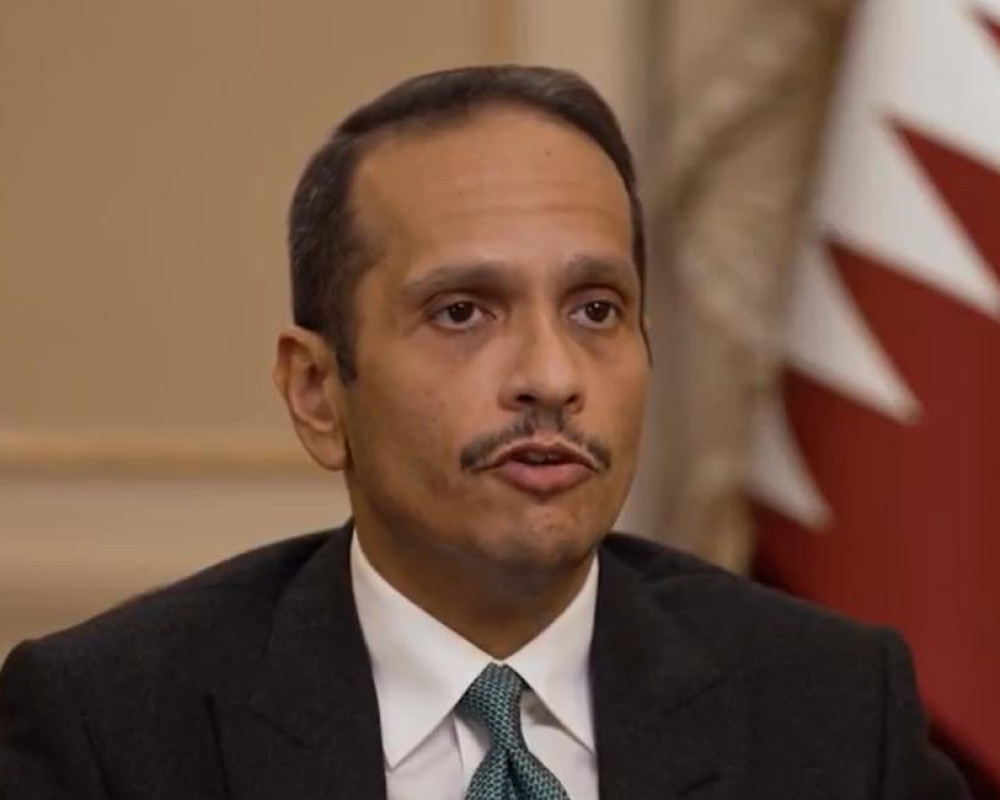
Prime Minister and Foreign Minister of Qatar, Sheikh Mohammed bin Abdulrahman Al‑Thani, affirmed that he is working with the United States within the framework of the Gaza peace agreement to define specific authorities and a clearly outlined mandate for the international forces that will participate under the agreement. He added that these international forces must fundamentally “ensure the security of everyone — Palestinians and Israelis alike — so that neither poses a threat to the other.”
In an interview with the U.S. network CNN, he explained that when the parties were discussing President Donald J. Trump’s 20‑point plan for Gaza, they insisted that the security of the Gaza Strip be entrusted to the Palestinian Police and the Palestinian Authority. He pointed out that no one expects an Arab or Islamic force to fire on Palestinians, saying: “We want the Palestinian Authority to be the only body responsible for Palestinians — to take charge of affairs in Gaza and the West Bank.” He referred to ongoing talks among various Palestinian factions to ensure that a technocratic committee can handle Gaza’s affairs during the transitional period, stressing that the Palestinian Authority must assume authority in Gaza and the West Bank once required reforms are carried out — and that the two territories cannot be separated, as both are the future of the Palestinian state — emphasizing that the only solution is the two‑state solution.
The Qatari prime minister described the cease‑fire deal as “very complex,” noting that “Israeli violations are disproportionate,” and explaining that they occur daily, just as with the prior cease‑fire agreement in January. He said that the “operations room to prevent escalation, which was formed together with Egypt and the United States,” intervenes to ensure the cease‑fire holds. “What happened yesterday: yes there was a violation at first, but the (Israeli) attack was entirely disproportionate, and nearly jeopardised the agreement.”
In another context, Al‑Thani said that mediation is part of Qatar’s identity and its national security. In response to a question about the nature of the relationship between Qatar and Iran, he noted that Iran is a neighbouring country and the two share the largest oil‑field in the world; Iran is part of the region and must be engaged. He expressed his desire to see Iran flourish and develop, saying: “Of course we do not want a nuclear arms race in our region, which is why we always support diplomacy, and that Iran should come to an agreement with the United States and European nations, so that its nuclear programme is placed under supervision.