Gaza -
Since October 2023, Gaza has not simply lost classrooms; it has lost much of the public education system that once made schooling accessible regardless of a family’s income. The schools in Gaza were damaged or destroyed by the Israeli military operation; others became shelters, and hundreds of thousands of children were pushed out of sustained face-to-face learning. What began as an emergency has evolved into something deeper: a widening gap between children who can pay for education and those who cannot.
A report by the Ministry of Education and Higher Education to monitor the reality of education between 2023 and 2026, cited by Laststory, stated that the system is now suffering from a “severe erosion of its components” because of the destruction of infrastructure and the disruption of educational cadres and resources, as 277 out of 584 schools in the Gaza Strip were destroyed completely or partially, and the rest of them were turned into shelters for the displaced. This government documentation is combined with data from UNESCO, which said by July 2025 that 97% of the sector’s school buildings had been damaged and destroyed to varying degrees.
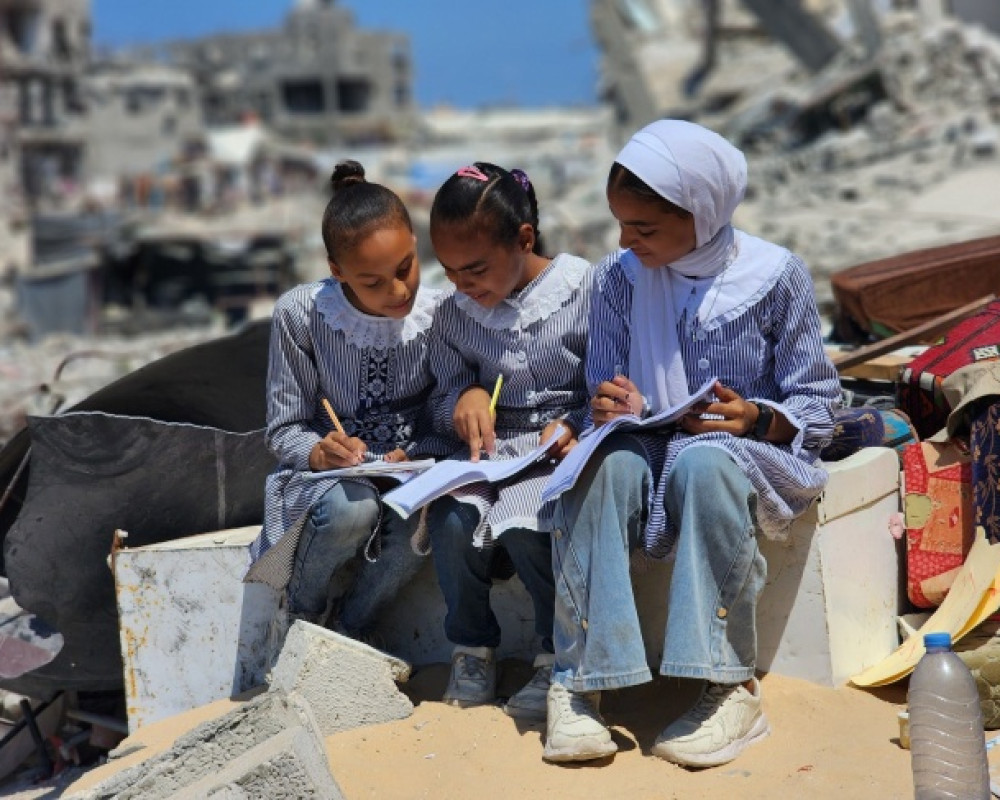
In 2024, after a full year of war, the Gazan people began to realize that the crises of losing the right of education not only included physical destruction but also schools reshap to sheleters, displacement prolonged, access to learning materials restricted, and education itself became fragmented. They attempted to resume education by establishing "temporary field learning points" through individual and institutional efforts before the ministry approved them in 2025 as emergency alternatives. However, the ministry's own report describes these points as fragile alternatives that do not perform the functions of a regular school in terms of education, interaction, and protection. which these alternatives made from tents constitute 53.5% so that they lack the minimum elements of educational logistics.
This field reality has resulted in a decline in school days from 200 days per year to only 60 days, a decrease in weekly classes from 30 to 12 classes, and a reduction in the curriculum to "basic competencies." The ministry's data confirms that the cognitive value of the educational year during war does not exceed 30% compared to normal years, while the cumulative educational loss devours about 700 hours annually.
The opening of some educational spaces or the launch of formal electronic programs by UNRWA does not in any way mean "restoring education." Returning to a tent without seats or books does not restore cognitive interruption. Figures from the Ministry of Education reveal the true extent of this crisis: there are 168,790 students in Gaza (27.3%) who are not enrolled in any formal education, while 127,569 children (20.6%) are completely absent from any formal or electronic learning environment.
This destruction extends deep into children's institutional and social memory. Children who were in kindergarten before the war and are now in the primary grades have never known the founding features of the school: the morning assembly, the class bell, break between classes, the school board cast, and student activities such as the school parliament and choir that built the values of participation in school society. As these children moved to the tents class, the school formed in their minds as a marginal, random environment. I remember asking my eight-year-old cousin, Ahmed Abo Aisha, about his school, and he said to me clearly, "I want to leave school to fill up on water. Filling up on water is more important." Ahmed summed up a perilous shift in a child's priorities, who suddenly believes that survival is more important than learning. This fact raises more than simply the loss of years of study: how long will it take to convince a child that learning is a necessity, not manual labor?
Yet the deeper, more sinister crisis lies in how this protracted war has turned education into a commodity, entrenching a steep class divide. On paper, the system claims progress: the Ministry of Education recently announced the launch of the 2026–2027 school year, with news outlets like Reuters reporting that roughly 660,000 students have returned to government facilities, UNRWA shelters, and makeshift learning sites. But we must be honest about what is happening on the ground: reopening physical spaces is not the same as restoring education.
The vast majority of these children are returning to battered tents, plastic tarps, and damaged structures that offer little more than a fragile illusion of learning, utterly stripped of basic tools and stability. Standing in sharp contrast to this crumbling, free option is a booming market of private, commercial schools attempting to replicate the pre-war environment. The catch, however, is unaffordable to the most families in Gaza: they charge steep fees in US dollars amid a total liquidity drought and widespread loss of income, turning quality education into an exclusive privilege for those who can pay.
At a private school like "Ebda'a Belahood Model School," simply reserving a seat costs a non-refundable $40. Monthly tuition starts at $100 for kindergarten and climbs to $203 for high schoolers. In a society grappling with rampant unemployment and hyperinflation on basic food items, $203 a month easily swallows an entire household's remaining income, if any exists at all or equals what it takes to feed a family for months.
This is where the real divide hits home. Parents are forced into an agonizing choice: leave their children in free, overcrowded tents that barely teach basic literacy, or drain their very last savings just to secure a seat in a private classroom that offers actual learning.
Samah Al-Sharif, 37 years old, who was forced to remove her son from private school, expresses this painful trade-off, saying, "I did not remove him because I did not want him to receive an education, but because I was no longer able to pay. Every amount I pay means I will deprive the house of another basic need. "Maysa Muhna, 35 years old, also recounts having to work to secure her son Hamza's seat: “My son has been distracted since the war and has not benefited from the initiatives. I had to work to enroll him in a private school because I am afraid for his future.”
Before October 7, private schools constituted no more than 5% of the educational sector in Gaza, while public schools and UNRWA schools provided free education to 95% of the children in the Strip and created an equal social space that promoted social mobility; the camp son and the son of the well-off family sit on adjacent seats and compete only with their competence.
The danger is not only that Gaza’s schools have been destroyed. It is that the longer education remains divided between fragile free alternatives and fee-based schools, the more deeply that destruction may reshape society itself. A system that once allowed children from refugee camps and wealthier neighborhoods to sit in the same classrooms is being replaced by one in which the ability to continue learning increasingly depends on what a family can afford.
The ruins of Gaza’s schools are visible. The deeper danger is less visible: a generation growing up with unequal access to knowledge. Rebuilding Gaza’s education system, therefore, cannot mean simply rebuilding classrooms. It must also mean rebuilding the principle that education belongs to every child, regardless of the family’s income.