London / PNN /
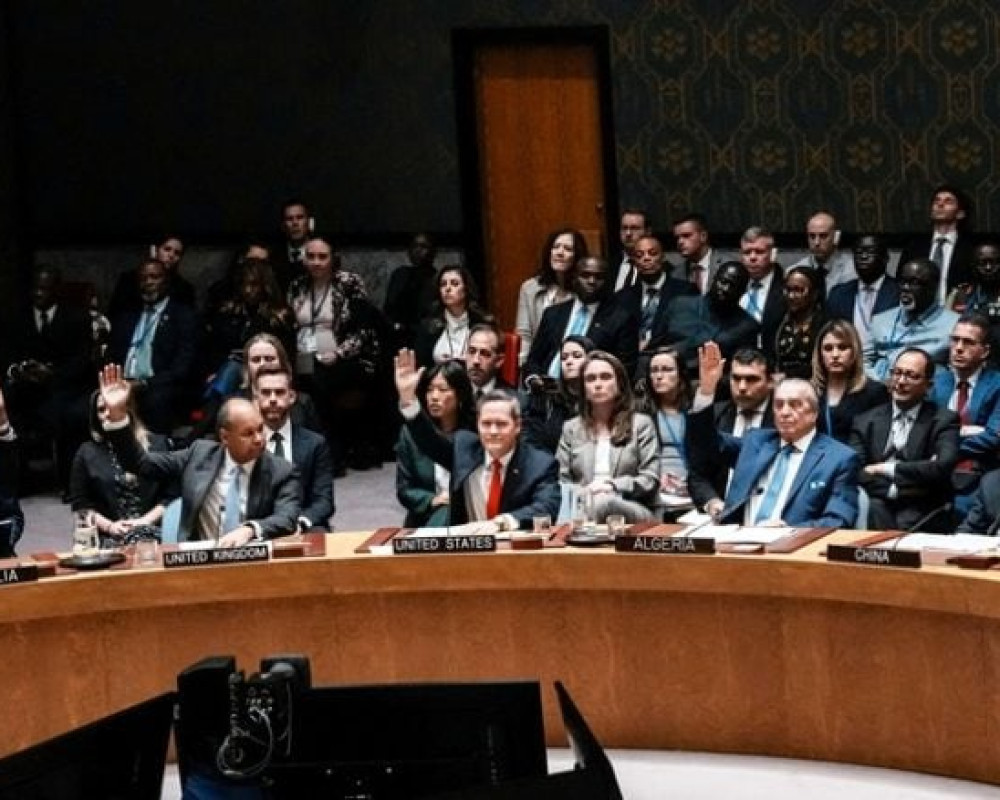
The Guardian published a report by Julian Borger describing the United Nations Security Council’s decision on Gaza as one of the strangest and most ambiguous in its history, particularly since the resolution mandates that the “Peace Council” in Gaza oversee an international stabilization force whose participating countries remain unclear.
Borger noted that the Security Council’s decision, passed on Tuesday evening and intended to turn Gaza’s fragile ceasefire into a genuine peace plan, “is one of the oddest decisions in UN history. It grants Donald Trump absolute control over Gaza, and Tony Blair may effectively report directly to him on the ‘Peace Council,’ which will oversee multinational peacekeeping forces, a committee of Palestinian technocrats, and a local police force for a period of two years.”
He added that no one knows who will actually participate in the Peace Council. As Trump announced on social media: “I will chair it and it will include the strongest and most respected leaders from around the world.” The council will report to the Security Council but will not be under UN authority or subject to previous UN resolutions. It will oversee the international stabilization force, whose size has yet to be determined. The U.S. intends to deploy it by January, though countries contacted, including Egypt, Indonesia, Turkey, and the UAE, have expressed hesitation so far.
The resolution states that the stabilization force will ensure a “disarmament process” in Gaza, implying it would have to confiscate weapons from Hamas, which immediately declared after the UN vote that it would not disarm. Borger commented that few countries appear willing to confront the battle-hardened militants. Meanwhile, Israeli security forces are expected to maintain order in areas currently occupied by Israel, though this could spark clashes if Israel hesitates to withdraw. Similarly, little clarity exists regarding the Palestinian technocrats who would manage Gaza’s daily affairs under Trump and his allied leaders, as it will be difficult to find technocrats willing to cooperate with Trump or who could influence Gaza’s 2.2 million residents. The same uncertainty applies to the proposed local police force.
Despite this opacity, Security Council Resolution 2803 grants these ambitious bodies the force of international law, in an effort to turn Trump’s 20-point peace proposal into a workable plan and strengthen the fragile U.S.-brokered ceasefire into a lasting peace.
The resolution passed with 13 votes in favor, none against, and abstentions from Russia and China—highlighting its deliberate ambiguity, as well as global fatigue and despair over the Gaza war, which has lasted more than two years, killed over 70,000 people, and destroyed roughly 70% of the coastal enclave’s buildings. A UN committee has determined that Israel committed acts amounting to genocide in Gaza.
Following the vote, U.S. Ambassador to the UN Mike Waltz described the resolution as “a pivotal new pathway in the Middle East for Israelis, Palestinians, and all peoples of the region alike.” Other Security Council members spoke cautiously, basing their support on the implications rather than the explicit text.
This was particularly evident regarding the Palestinian state. Under pressure from Arab and Islamic countries, the resolution was modified in its final days to at least mention the future State of Palestine—but without explicitly recognizing Palestinians’ fundamental right to self-determination or an unequivocal commitment to the two-state solution. It states only that if the Palestinian Authority reforms satisfactorily and Gaza’s reconstruction proceeds, “conditions may become suitable for a credible pathway toward Palestinian self-determination and statehood.”
Although largely symbolic, European diplomats considered it a victory to have persuaded the Trump administration envoy to pronounce “Palestinian self-determination and statehood” aloud, despite the caveats.
Former U.S. negotiator and Middle East expert Aaron David Miller described the resolution as a step toward a future Palestine. He wrote on social media: “It is unclear whether the Security Council resolution is enforceable, but it reflects two new realities: the internationalization of Trump’s Gaza initiative and support for a two-state solution as the ultimate resolution.”
The Guardian also noted that Resolution 2803 was unacceptable to the far-right within Benjamin Netanyahu’s coalition, prompting him to reiterate strong objections to any proposal for Palestinian sovereignty. Governments supporting or tacitly endorsing the resolution found some reassurance in the far-right’s anger. European and Islamic countries believe passing the resolution will keep Trump engaged, increase humanitarian aid to Gaza, and leave the door open for a lasting peace and Palestinian statehood.
Optimists argue that the greater the international representation on the Peace Council and the more Arab and Islamic countries participate in the stabilization force, the harder it will be for Israel to maintain exclusive control over the occupied territories—a control currently backed by the U.S. By engaging with Trump’s “plan,” they hope to eventually outmaneuver Israel, leveraging the U.S. president’s vanity to guide him toward their preferred outcomes.