Gaza / PNN /
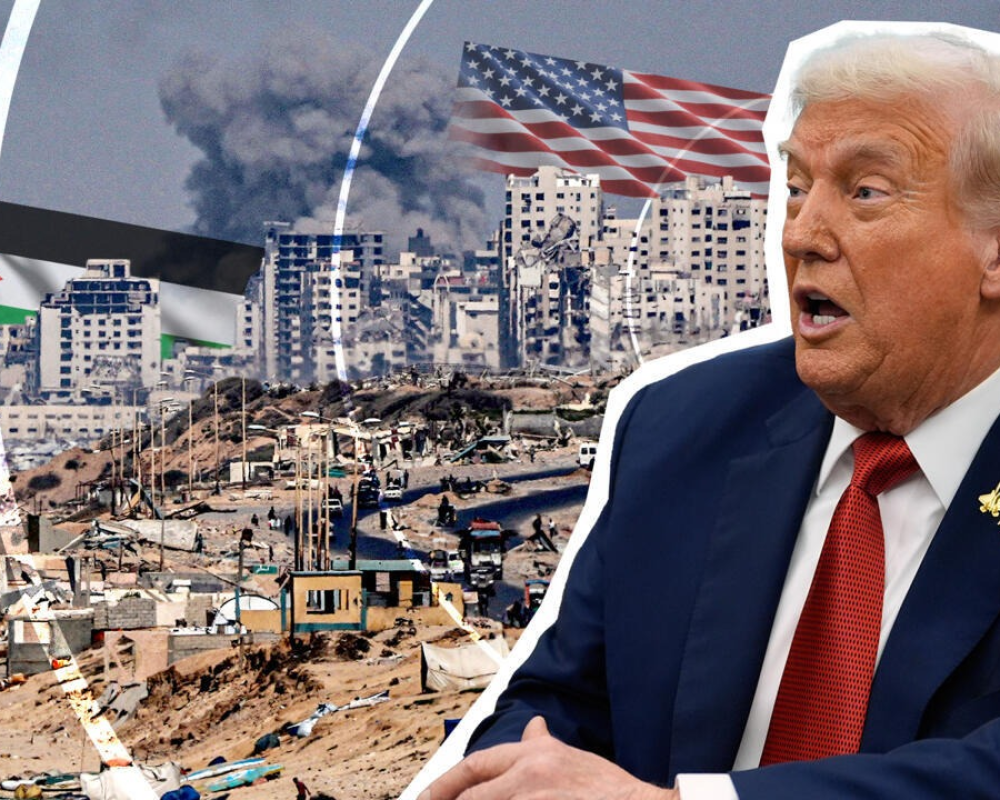
For weeks, the United States has been working to secure the passage of a draft resolution at the UN Security Council to establish a temporary international force in the Gaza Strip, known as the International Stability Force (ISF). The force is part of a comprehensive plan to rebuild and secure the strip until the end of 2027, with the possibility of extension.
The U.S. prepared this draft resolution for the international force based on former President Donald Trump’s 20-point plan to end the war in Gaza. The force is expected to replace the Israeli army as soon as it enters the strip.
The draft plan has been described as “sensitive but not classified,” referring to its operational rather than political nature. A senior U.S. official told Israel’s Channel 12 that “this force is not for peacekeeping; it is meant to enforce stability and prepare the ground for a new Palestinian government under international supervision.”
This plan represents the clearest American version so far of the “day after” vision for Gaza, following two years of continuous Israeli military assault.
The U.S. project aims to strike a careful balance between Israel’s security interests and Washington’s strategic priorities in the region.
Amendments to the U.S. draft resolution were published for the third time last Thursday. Israeli political sources told Yedioth Ahronoth that the new proposal includes “elements unfavorable to Israel,” such as references to a pathway toward a Palestinian state and a clause preventing Israel from vetoing which countries may contribute forces.
Political analyst Wassam Afifa said the U.S. draft submitted to the Security Council represents a strategic turning point in Washington’s approach to the Israeli-Palestinian file, as it carries dual goals: imposing a multi-party security arrangement in Gaza while simultaneously reinforcing U.S. influence and supporting Israel under looser conditions than before.
Conversely, Israeli affairs specialist Firas Yaghi argued that the U.S. resolution essentially represents explicit American trusteeship over Gaza, since the chain of command for the ISF and the Peace Council would be purely American, not under UN Chapter VII authority.
He noted that the Security Council’s role appears merely symbolic, with the ISF required only to submit semiannual reports for review.
Yaghi added that the aim is to secure political and security gains after Israel’s U.S.-backed offensive in Gaza and the region—gains aligned with Israeli security interests and U.S. strategic objectives, foremost among them normalizing relations between Israel and Arab states, blocking Chinese and Russian influence, and containing Iran.
He stressed that the U.S. draft reveals a complete re-engineering of the Gaza equation, replacing direct Israeli control with a “multi-party security sovereignty” managed by Washington and monitored by Tel Aviv.
This falls under a strategy of “stability in exchange for security,” granting Israel maximum security guarantees without the cost of occupation, while giving the U.S. a new political lever in the Middle East—reshaping regional influence and making Gaza a model of “security first, statehood later,” subject to U.S.-Israeli approval rather than tied to Palestinian Authority reforms with clear deadlines.
The draft establishes a new conflict-management framework by linking the gradual withdrawal of Israeli forces to meeting “agreed-upon security criteria,” chiefly the complete disarmament requirement.
Instead of setting a timetable—as in previous plans—the proposal sets withdrawal phases based on “the ISF’s progress in implementing its security tasks,” effectively granting Israel a de facto veto over any final withdrawal.
Haaretz quoted an Israeli security official saying: “We will not withdraw from Gaza before ensuring that not a single gun can ever again be aimed at Israel.”
The draft also allows for a “limited Israeli military presence” along Gaza’s perimeter to monitor borders and crossings, resembling the “security belt” model Israel used in southern Lebanon from 1985 until its withdrawal in 2000.
Despite language that allows Israel to use withdrawal as a diplomatic pressure tool, Israeli security officials are questioning the clarity of the U.S. plan. Haaretz reported growing uncertainty about Washington’s intentions, noting that the government appears to have approved elements of the plan in secret discussions without involving security officials.
According to the report, some officials fear political retaliation and say they were not asked to assess the consequences of the wide-ranging moves Washington is planning in Gaza.
One official stated: “We have lost our ability to influence or make our voice heard. Strategic moves are taking place before our eyes, with implications for Israel’s future, and we have no say in them.”
The draft creates a so-called “Peace Council,” designated as the civil-political body responsible for coordinating administrative and humanitarian activities in Gaza, under which the ISF would operate.
The text suggests that the Peace Council would function as a political façade legitimizing U.S. oversight rather than an independent supervisory body, since its reports would be tied directly to U.S. funding and State Department recommendations rather than UN resolutions.
The draft positions the United States as the “primary guarantor” and assigns participating Arab countries a coordinating role in reconstruction and security support.
Expected guarantor states include Egypt, Jordan, the UAE, Morocco, and Saudi Arabia. Turkey remains disputed, as Israel opposes its involvement in the international force.
According to the Channel 12 report by Barak Ravid, Israel pressed to exclude Turkey from the security component, while Washington proposed allowing Turkey a “limited humanitarian role.”
The reluctance toward Turkish participation, combined with hesitations from the UAE and Saudi Arabia, means the list of guarantor states is not finalized. This highlights a new “division of influence” dynamic: Israel insists on an Egyptian role at the border, the U.S. seeks security trusteeship, and Arab states seek political concessions, particularly related to Palestinian statehood.
The international force is the core of the U.S. plan—its executive arm for securing Gaza after the Israeli army’s withdrawal.
According to Bloomberg, the force would comprise 12,000–15,000 personnel from “selected” Western and Arab states, operating under unified U.S. command.
The resolution would authorize the force to use “all necessary means” to ensure disarmament and prevent threats, which, according to Haaretz, means the ISF “would have authority to conduct limited military operations inside Gaza if required.”
However, the draft does not specify accountability mechanisms if the force fails, and it implicitly states that Israel has “the right to resume military operations in coordination with the U.S. if terrorism returns.”
Israeli public broadcaster Kan reported that the Israeli army is preparing to disarm Hamas concurrently with renewed fighting should Trump’s international-force plan fail.
Afifa argued that while details of the ISF plan remain vague, the draft grants the force broad powers—including “all necessary measures” to dismantle military structures and rebuild Palestinian police. If the force fails, Israel could resume operations independently, risking international repercussions and potential confrontations with international law.
Meanwhile, Russia distributed its own draft resolution to Security Council members on Thursday, in coordination with China, as part of a separate approach to ending the war in Gaza.
This step represents a major obstacle to the U.S. draft and could delay or prevent a vote on what is known as “Trump’s plan to end the Gaza war.”
According to Channel 12, negotiations took place in recent days between Washington and Moscow over the U.S. text, but Russia decided Thursday evening to block the planned Friday vote.
Barak Ravid’s analysis of the Russian draft noted that it makes no reference to disarmament or to the disarmament of Hamas, distinguishing it from the U.S. draft that centers on deploying an international force and creating a “Peace Council” overseeing a technocratic Palestinian government in Gaza.
Instead, the Russian draft places responsibility for exploring international-force deployment on the UN Secretary-General, rejects any predetermined Israeli withdrawal map, and opposes a “buffer zone” at the Gaza-Israel border.
It also stipulates that the Security Council must “reject any attempt at demographic or territorial change in Gaza, including any action that reduces its territorial area.”
The Russian text expands the political dimension by reaffirming the two-state solution and stressing that Gaza must be under Palestinian Authority control, affirming the “unity and territorial integrity of Gaza and the West Bank under PA authority.”
Meanwhile, the United States—along with Qatar, Egypt, the UAE, Saudi Arabia, Indonesia, Pakistan, Jordan, and Turkey—issued a joint statement Friday evening supporting the U.S. draft resolution, which Washington said it prepared “after consultations and cooperation with Council members and regional partners.”
The statement endorsed the “historic comprehensive plan to end the conflict in Gaza,” announced on September 29 and adopted at the Sharm El-Sheikh Peace Summit.
Western diplomats described the statement as a calculated move by Washington to retain support for its proposal.
To pass the U.S. resolution, Washington needs 9 votes in the Security Council—a difficult task in light of opposition from Russia and China. Pakistan, a non-permanent member, has expressed support for the U.S. draft, while Algeria remains undecided, making it a potential swing vote.
Four diplomats told The New York Times on Friday that major disagreements persist among Security Council members, noting that “China wants the entire U.S. plan removed from the resolution.”
Russia, Algeria, and France are demanding explicit language supporting Palestinian statehood, while several countries seek clarity on the role of the Peace Council and the Palestinian Authority in Gaza’s “transitional administration.